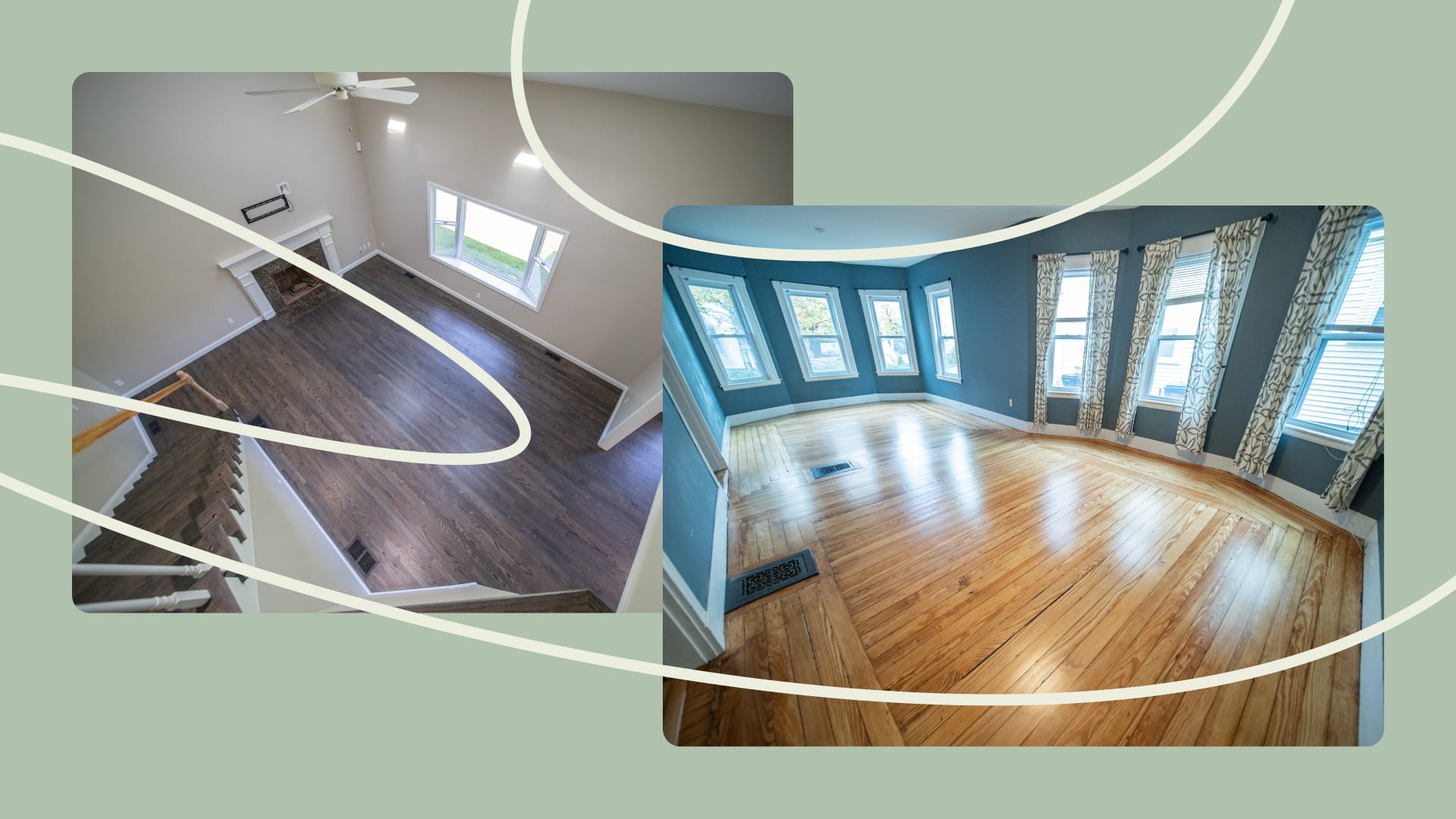





The hardwood flooring trends for 2026 point one way: warmer color and less shine. Boards are getting longer and wider too, and cool gray and high gloss are on their way out. The National Wood Flooring Association (NWFA) saw the same shift when it surveyed wood flooring businesses for its 2026 outlook. Members reported falling demand for gray and red tones, rising demand for natural and brown ones, and more customers asking for long, wide boards.
A trend only helps if it fits your house and the way you live in it. For each one below, we say whether you can get it by refinishing the floor you already have, or whether it takes new boards. We do both. Our crews sand and refinish floors across Massachusetts, New Hampshire and Maine, and the engineered white oak, ash and oak on the walls of our Chestnut Hill showroom are sold by the square foot.
Which 2026 trends work on the floor you have
Color and sheen live in the top of the floor, so a sand and refinish can change them. Board width, length, pattern and texture are built into the boards themselves. If you want those, you are buying a new floor.
| Trend | By refinishing your current floor | With new boards from our showroom |
|---|---|---|
| Warm honey and caramel tones | Yes. A warm stain, or an Amber or Classic sealer tone | Cognac White Oak, Caramel Oak herringbone |
| Light, natural oak | Yes on white oak. Red oak stays warmer | Brie White Oak, Mascarpone White Oak, Bianco herringbone |
| Rich dark brown | Yes. A dark stain such as Jacobean | Oak Trapani herringbone, Coffee Ash |
| Matte or satin sheen | Yes. The sheen is chosen at the finish coat | Every board is matte or semi-matte lacquer |
| Wider, longer boards | No | 5" to 8-1/8" wide, up to 86-5/8" long |
| Herringbone | No | 5" x 28-1/2" blocks, bleached white to dark chocolate |
| Brushed texture | Not usually. It comes built into new boards | Every board we stock is brushed |
1. Warm tones: honey, caramel and mid-brown

Nearly half of the businesses in the NWFA survey said demand for brown floors is growing, and the Houzz 2026 kitchen trends report found wood tones were the top choice for kitchen floor color, at 49%. What has changed since the 1990s is the shade. A warm floor now is golden or toasted, and it stays away from the orange honey oak that plenty of Boston-area homes still have under the rugs.
When we refinish a floor warm, we usually start from a few Bona DriFast stain colors. Golden Oak gives the honey look. Nutmeg and Provincial sit a step deeper. Special Walnut is a warm mid-brown that hides wear well in a busy kitchen. Staining adds about 3 to 5 working hours per 1,000 sq ft, because it is an extra step between sanding and the first finish coat.
If you want warmth without a stain, a water-based sealer tone can do part of the job. We use five: Nordic, Natural, Classic, Intense and Amber. Amber and Classic deepen the wood's own color toward gold. They take less time than a stain, but they cannot turn a pale floor dark.
For new floors, Cognac White Oak is a warm antique brown in 8-1/8" boards. Caramel Oak and Oak Brown Sugar give the same warmth in herringbone.
2. Light, natural oak
The other big direction is pale oak that looks close to raw wood. In the NWFA survey, white oak was the main domestic species for 63% of member businesses, and light and natural tones were both on the list of what customers ask for.
How light you can go depends on what your floor is. White oak takes a Nordic or Natural sealer tone well and stays pale. Red oak, which you find in plenty of older Boston houses and triple-deckers, has a pink undertone that shows through clear finishes and light stains. Bona's own stain chart is printed on red oak, and the same can of stain looks different on white oak. That is why we lay samples on your boards before anything is picked.
Light floors hide dust and pet hair better than dark ones. They react more to strong sun, though, and a south-facing room with no shades will change color faster (we wrote up what helps with sun damage separately).
New options in the showroom include Brie White Oak in white, Mascarpone White Oak in a soft cream, and Bianco herringbone, which is bleached for a near-white floor. If you want a color that will still look right when you sell the house, natural or light-to-medium brown oak is a safer bet than any single trend.
3. Dark floors, in the right rooms

Are dark wood floors out of style? No, but they are chosen more carefully than they were. Deep brown and espresso floors still show up in 2026 designs, mostly in rooms with good light and less traffic, like a dining room or a Back Bay parlor with tall windows.
The catch is upkeep. Dark floors show dog hair and fine scratches more than any other color. In a Boston entryway, where winter brings in sand and road salt, a near-black floor will look gray by February. A matte finish and a brushed surface both help, which is why the dark boards we stock have both.
For a refinish, Jacobean gives a deep brown and Ebony gets close to black. You can see both on our dark stain page. For new floors, Oak Trapani herringbone is a dark chocolate color, and Coffee Ash is dark brown with strong grain and a semi-matte lacquer.
4. Matte and satin instead of gloss
High gloss has dropped faster than any other look of the last few years. One respondent in the NWFA survey put the reason simply: "They don't want the glare or sheen." A matte or satin floor hides the scratches and footprints that a glossy floor puts on display, and you see the wood grain instead of a reflection of the window.
Sheen is chosen at the finish coat, so any floor we refinish can go matte. The finish system also decides how long you are out of the room. Water-based coats dry in 1 to 2 hours. With Bona Traffic HD, the floor is ready for furniture in about 3 days, and Bona Mega One in about 5. Oil-based finishes take 12 to 15 hours per coat and about 14 days to cure, and we do not recommend staying in the house while they go down. More on the choice in our polyurethane guide.
Every prefinished board in our showroom comes with a matte or semi-matte lacquer, so a new floor starts low-sheen from day one.
5. Wider and longer boards

Longer, wider boards were on the NWFA list of what customers want in 2026. Fewer seams make a room look calmer and larger, and a wide board shows more of the grain. The boards we stock run 5" to 8-1/8" wide and up to 86-5/8" long, which is just over 7 feet.
In New England, a wide board needs more care. Indoor air is humid in August and very dry once the heat comes on, and solid wood follows it. Thin gaps open in February and close again by June. The wider the solid board, the bigger that movement. That is why our wide boards are 9/16" engineered, why we glue boards wider than 3-1/4" on installs, and why we keep the subfloor and the wood within 4% moisture of each other before a single board goes down.
Going wider is not an upgrade by itself. If you live in a Victorian row house in the South End or Back Bay with its original narrow-strip oak, refinish it. That floor was made for the house. One NWFA member even said narrow boards are coming back with mid-century designs. If you are still weighing it, read our wide plank pros and cons.
6. Herringbone in one or two rooms

Herringbone keeps growing, and in 2026 it is used as a feature more than a whole-house floor. An entry hall or a dining room gets the pattern, and the rest of the house gets straight boards in the same color. A border or a clean transition where the two meet makes it look planned.
Our herringbone blocks are 5" by 28-1/2", and the newest ones use a click joint made for the pattern, which makes them easier to install. Colors go from Bianco (bleached white) and Balos (creamy white) through Mainland (warm brown) to Trapani (dark chocolate).
Herringbone takes more cutting and more waste than straight plank, so it costs more per square foot to install. We quote installation separately from material, so you can see exactly what the pattern adds.
7. Brushed texture and natural variation

Perfectly smooth, perfectly matched boards look less current than they did. The 2026 look is wood that shows its knots and some color change from board to board. Brushing does this by taking out the softer wood between the grain lines, so the harder grain stands up and you can feel it under your hand.
A brushed surface also hides small scratches and dents, because they blend into the texture. That is one reason it suits homes with dogs (our pet-friendly flooring guide has the rest). Every board we stock is brushed, and some, like Mainland, show strong knots and grain on purpose.
8. Keeping the floor you already have
The lowest-impact floor is usually the one already in the house. Solid hardwood can be sanded and refinished several times over its life. A refinish takes 21 to 33 working hours per 1,000 sq ft at our Essential level, and 31 to 46 at Premium, where the surface is refined for strong daylight. That is a lot less material and waste than tearing a floor out.
The finish matters too. The water-based finishes we use are low in VOCs, so you can often stay home while we coat, with the room ventilated. When you do buy new wood, ask where it came from. Certification from the Forest Stewardship Council (FSC) is the most common proof of responsible sourcing.
Some people are also coming back from vinyl. Two-thirds of NWFA members said wood-look products like LVP hurt real wood sales, but one member described customers with worn-out vinyl switching back to wood. Our hardwood vs LVP comparison looks at what each does for resale.
9. Engineered boards for slabs and radiant heat
NWFA members report that engineered flooring keeps gaining, and that factory-finished boards are in demand. One respondent tied it to new homes built with radiant heat. An engineered board has a real wood top layer over a stable core, so it moves less than solid wood when humidity changes.
In Boston, that matters on concrete and on lower floors. Condos in the Seaport and Fenway often sit on plywood or a concrete slab. Garden-level rooms in the Back Bay and South End get summer damp coming up through the floor. The boards in our showroom are 9/16" engineered, and most are rated for underfloor heating. Solid still makes sense on a wood subfloor upstairs, and our engineered vs solid guide walks through where each one belongs.
Be careful with "waterproof hardwood." A better coating and a better core slow water down, but standing water still damages wood. A leaking dishwasher or a burst pipe will reach the boards eventually. When it does, water damage repair is a separate job.
10. Wood next to tile, rugs on top
More homes use tile where water and winter boots land, like the mudroom or the bathroom, and wood everywhere else. Where the two meet matters most. The transition should sit at a doorway or a clear line in the room, not in the middle of a walkway. On top of the wood, a large area rug softens a living room and protects the busiest path. Just use a pad that will not stain the finish; the rug pad guide lists the safe types.
11. A color mixed for your floor
The most useful idea for 2026 is a color chosen for one specific house. Bona DriFast stains can be blended, so a floor can land between two stock colors, for example a warm brown with a little gray in it to match kitchen cabinets. We confirm the mix on your own boards before we coat the floor.
For new floors, it helps to see whole boards, not two-inch chips. Every floor in the Chestnut Hill showroom is on the wall as a full plank. Pick two or three trends that fit your house and skip the rest. A warm matte floor in wide boards can look settled for decades. Add a dark stain and a pattern to the same floor and it may look busy by next year.
What's going out in 2026
Cool gray is first on the list. It was everywhere in the 2010s, and the NWFA survey shows demand for it still falling. Red-toned floors like cherry and mahogany stains are fading with it. High gloss is out for the practical reasons above. Perfectly uniform boards and printed "barnwood" looks are giving way to real grain and natural variation.
If you have a gray floor you are tired of, you do not need new boards. We sand the gray off and stain or seal the wood in a warmer tone. Gray is not wrong everywhere, though. We still stock a few gray and smoked oaks, like Marsala, because they suit some modern condos with cool stone and white walls.
Looking ahead to 2027
Nothing in the 2026 data points to a reversal. Brown and natural tones, longer boards and low sheen were all still growing in 2026, and we expect that to carry into next year. If you are planning a floor you will keep for ten years or more, pick its color for the house and let the rug and the paint follow the trends, since they cost far less to change.
Sources: 2026 NWFA Industry Outlook, Hardwood Floors Magazine, October 1, 2025. Houzz 2026 Kitchen Trends Report, via Forbes, January 13, 2026. Stain color names from the Bona DriFast color chart.
Questions or Feedback?
If you want us to review your floor case or clarify anything in this guide, send us a note.
Email: weles.usa@gmail.com